
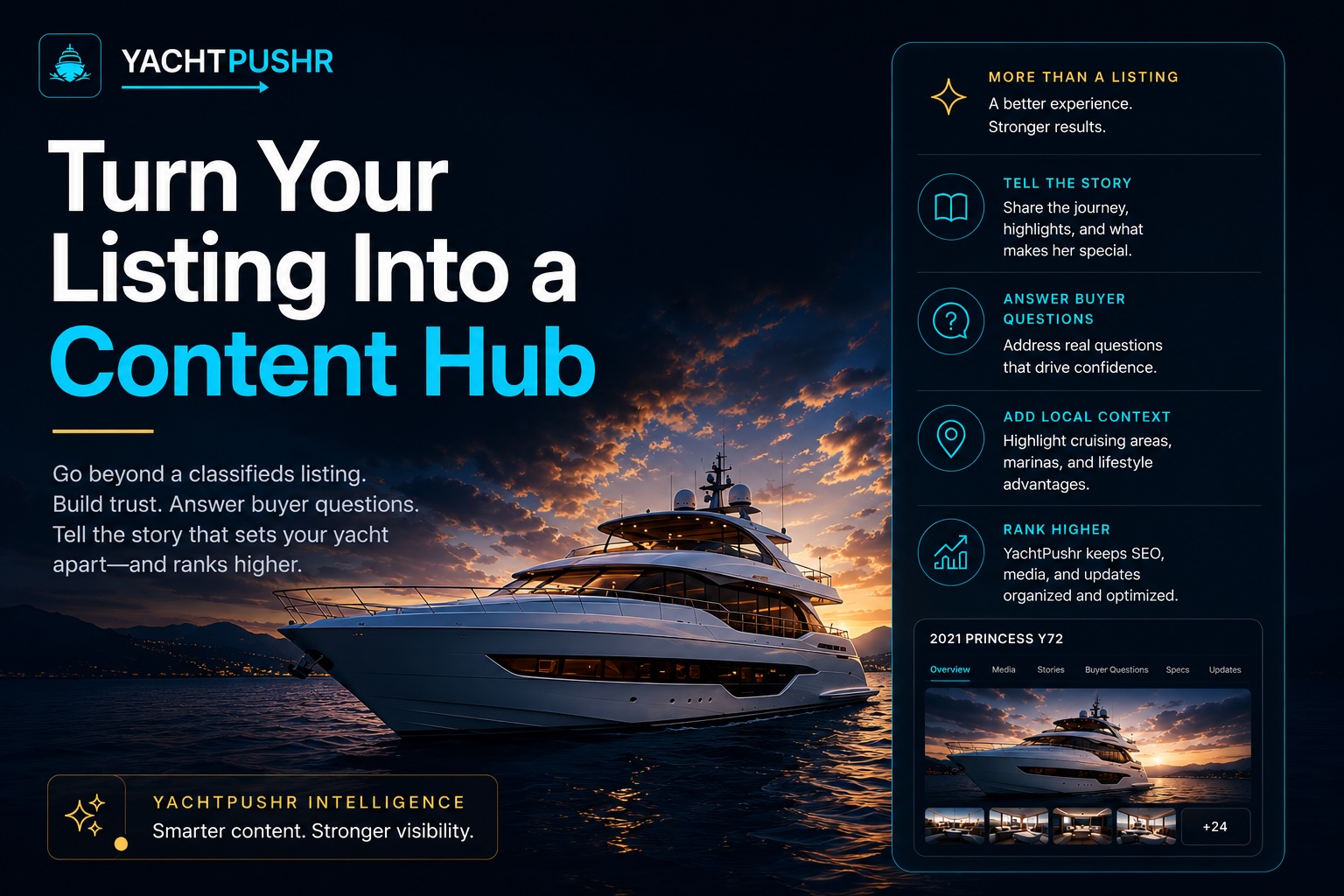
Why Your Yacht Listing Page Should Be a Content Hub, Not a Classifieds Entry
Most yacht brokers still treat listing pages like digital classifieds: a few photos, a specs table, a short description, and a phone number.
That approach might have worked when buyers relied on MLS feeds and print magazines. Today’s buyers research like analysts: they compare, search, bookmark, and share. If your listing page doesn’t answer their questions better than the big marketplaces, you’re training them to shop somewhere else.
Turning each listing page into a content hub changes that.
Instead of a static content, your listing becomes a living resource filled with stories, explanations, and context—designed to attract organic traffic, keep visitors engaged, and build trust in your brokerage’s expertise.
Below is how to structure listing pages as content hubs, why it works, and how YachtPushr keeps the content, SEO, and updates organized without burying your team in extra work.
From “Specs + Photos” to a Content Hub
A classifieds-style listing answers what the boat is.
A content hub listing answers:
- What this boat is really like to own
- Who it’s best suited for
- How it compares to alternatives
- Why this specific example is worth a closer look
- What local factors (cruising grounds, service, resale) matter
Structurally, a content hub listing page usually includes:
- Core listing details (price, specs, photos, video)
- Narrative story about the boat and owner history
- Buyer questions and answers
- Explanations of key specs and equipment choices
- Local context and usage ideas
- Supporting articles and resources linked on-page
You’re not changing what you say about the boat—you’re changing how thoroughly and clearly you say it.
Why This Matters: Competing With Marketplaces
Marketplaces win on aggregation: more boats, more data, more browsing.
Brokers win on expertise and local knowledge—if they put that knowledge on the page.
Content hub listings help you:
-
Differentiate your brand
Anyone can post specs. Not everyone can explain how this model behaves running into a steep chop at 20 knots or how the layout works for a Bahama hop with kids. -
Earn organic traffic
Google doesn’t just rank “42’ Sea Ray for sale.” It ranks “best layout for liveaboard couple,” “Sea Ray 420 Sedan Bridge fuel burn,” “Fort Lauderdale family cruising boat.” Content hub listings naturally capture these long-tail searches. -
Improve lead quality
Buyers who’ve read clear explanations, local context, and Q&A arrive better educated. Your conversations move faster and focus on fit, not basic information. -
Extend value beyond this one boat
Even if a particular listing sells, the content still attracts buyers researching that brand, model, or use case—and keeps them inside your ecosystem.
YachtPushr is designed around this exact shift: helping marine businesses turn individual listings into evergreen content assets, not one-off ads.
Four Content Layers Every Listing Hub Should Include
1. Stories: Turn Specs Into a Narrative
People remember stories, not spec sheets.
Add a short “Story of This Boat” section that covers:
- Ownership history in human terms (e.g., “Owned by a meticulous second owner, used primarily for weekend cruising out of Annapolis.”)
- How it has been used (cruising, day boating, fishing, charter)
- Notable trips or upgrades with a purpose (“refit in 2022 for extended Bahamas cruising”)
- Why it’s coming to market now
This gives buyers context they rarely get in marketplace entries and builds credibility in your assessment.
How YachtPushr helps:
YachtPushr can generate a first-draft narrative from your inventory data and notes (ownership, refit details, location, photos), then you refine the voice and details. The platform keeps the story versioned alongside specs and media so updates don’t break your layout or SEO.
2. Buyer Questions: Publish the Conversation
Every broker answers the same questions over and over:
- “What’s the real cruising speed and fuel burn?”
- “Can I run this boat easily as a couple?”
- “How does this compare to the [competing model]?”
- “Is this a good fit for the Bahamas / Great Lakes / Pacific Northwest?”
Instead of keeping those answers buried in your inbox, publish them.
Add a “Buyer Questions & Answers” section:
- Start with 5–10 common questions you know will come up
- Add new Q&A as real prospects ask them
- Mix model-specific questions (e.g., “How is the visibility from the lower helm?”) with ownership questions (“What’s typical annual maintenance on this size and brand?”)
This does three things:
- Anticipates objections and smooths the path to inquiry
- Signals honesty and transparency
- Creates search-friendly, natural-language content buyers actually use
How YachtPushr helps:
YachtPushr lets you centralize those recurring questions and apply them across similar listings, then tailor answers to each boat. Over time, YachtPushr Intelligence can highlight which questions get the most engagement and recommend new ones based on what buyers search and click.
3. Spec Explainers: Translate Technical Into Practical
Specs are only useful if buyers understand what they mean on the water.
Use short “What This Means for You” explainers for key items:
- Draft – Where this boat can realistically go in your region
- Beam – How it affects stability, slip requirements, and interior volume
- Engine package – Trade-offs in fuel burn, performance, and service availability
- Tankage – What range and off-grid time are realistic for common trips
- Stabilization / thrusters – Impact on sea comfort and docking confidence
For each important spec, answer:
- Why it matters
- Who benefits
- Any regional considerations (e.g., “This draft is ideal for the ICW and Keys, but not for frequent Bahamas anchoring in 5 feet of water.”)
How YachtPushr helps:
YachtPushr can generate spec explainers tailored to each listing’s configuration and home waters, using your preferences and playbooks. When specs change, the platform updates associated text so your SEO and accuracy stay aligned without manual rewriting.
4. Local Context: Connect the Boat to Your Waters
Marketplace listings rarely talk about place. Your brokerage should.
Add a “Best Suited For…” section anchored in your region:
- Typical cruising grounds this boat is ideal for
- Seasonal considerations (wintering, hurricane strategy, Great Loop suitability)
- Local service and storage realities for this size and type
- Marina and slip fit (especially for beam and height limitations)
- Charter or rental regulations if relevant
This is where your local expertise shines and where buyers realize, “This broker actually understands how I’ll use this boat.”
How YachtPushr helps:
YachtPushr stores regional templates and knowledge (e.g., Great Lakes vs. New England vs. Florida/Bahamas) and applies them intelligently per listing, so adding local context doesn’t become a fresh writing project every time.
Keeping It Organized: SEO, Media, and Updates Without Chaos
The hesitation many brokers have is simple: “This sounds great, but who has time to manage it?”
Without a system, content-heavy listings can become:
- Hard to update when specs change
- Inconsistent in layout and branding
- Messy from an SEO perspective (duplicate phrasing, broken links)
- Disconnected from social and email promotion
This is exactly where a platform like YachtPushr earns its keep.
With YachtPushr:
- Content stays structured – Stories, Q&A, spec explainers, and local context live in organized blocks tied to each listing.
- On-page SEO is handled intelligently – Titles, headings, meta descriptions, and internal links are optimized around both the specific listing and the broader search intent (brand, model, region, use case).
- Media is centrally managed – Photos, video, and virtual tours are stored once, correctly tagged, and reused across listing pages, social posts, and blog content.
- Updates propagate cleanly – Change a spec, refit note, or home port and YachtPushr updates relevant content areas and flags anything needing human review.
- Performance informs your next move – YachtPushr Intelligence analyzes which sections keep readers engaged, what they scroll past, and which questions drive inquiries—then recommends improvements.
Instead of more work for your team, the system converts what you’re already doing (answering questions, explaining trade-offs, talking about trips) into structured content that keeps working long after the first call.
Turn Every Listing Into an Advantage
Marketplaces are not going away. But they don’t have to own the relationship with your buyer.
When each listing on your site functions as a content hub:
- Buyers stay longer and learn more from you
- Search engines see you as a true authority, not just a feed endpoint
- Your brokerage brand becomes associated with guidance, not just inventory
- You generate compounding value from every listing—before and after it sells
If you’d like to see how YachtPushr can turn your current listings into high-performing content hubs—without adding hours to your week—reach out for a walkthrough of the platform and YachtPushr Intelligence.